Home / Industrial Paint Booths | Updated July 2026
Industrial Paint Booths - Cost Effective Solutions for Your Requirements
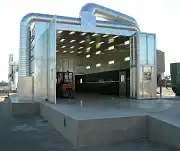
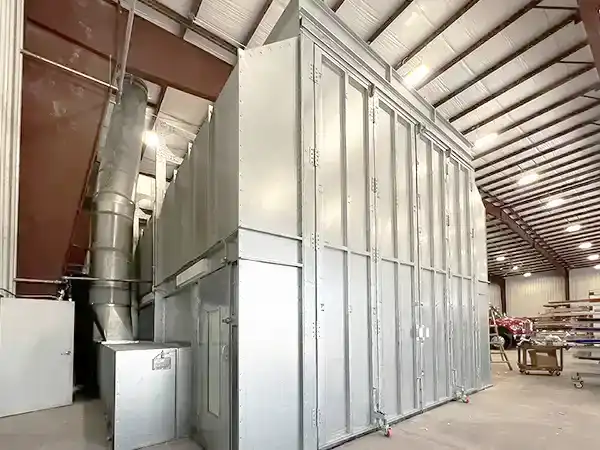
An industrial paint booth is a code-compliant, ventilated enclosure engineered for spray-finishing large equipment and high-volume production parts. AEI Paint Booths designs, manufactures, and installs custom industrial paint booths, spray booths, blast booths, and air makeup systems built to meet NFPA, OSHA, and NEC requirements. Since 2003 we have provided crossdraft, semi-downdraft, and downdraft booth systems for applications ranging from locomotives and railcars to RVs, mobile cranes, aircraft, and pipeline components across North America.
Industrial Paint Booths
We offer industrial paint booths, blast booths, personnel lift systems, and more. We will work with you to provide an industrial paint booth system that is integrated in to your overall workflow.
Industrial applications often move work through their facilty with some type of material handling systems. Whether you use 3 axis cranes, overhead conveyor systems, floor rail systems, or any other type of system we will work with you to provide a booth that will fit your process.
Products and Industries
We offer everything from standard automotive size booths to large custom paint booths for any size equipment or process. We have provided spray booths for vintage locomotives, railcar mounted electric generators, aircraft, R.V.'s, mobile cranes, pipe and pipeline components, cars, boats, and many more applications for clients that had specific production objectives.
Finishing Process Objectives
We will work with you to meet the objectives of your finishing process. How many items a day do you want to move through the system? How will the items being finished be moved through your facility? Are you painting newly manufactured items or refinishing items? Are you painting sub-assemblies or assembled units? If you are refinishing do you need to clean and treat the surfaces before painting? All important questions to ensure that you get the best system for your unique application.
Project Management
Many disciplines are involved in the installation process. Engineering, permitting, mechanical, electrical, plumbing/gas, as well as considerations of the existing building or new building. Our attention to detail in project management and coordination with all contractors, architects, and engineers will provide a seamless installation process.
Code Compliance
All of our paint booths are designed to meet or exceed the requirements and recommendations of the
NFPA, OSHA, and NEC.
What Comes Standard on an AEI Industrial Paint Booth?
Paint Booth Airflow Options:
Crossdraft Booth: Air enters the booth through filtered intake columns inside the front corners of the booth for a pressurized booth. The clean filtered air flows through the work area and is pulled through the filtered exhaust chamber at the rear of the booth by an exhaust fan.
Semi Downdraft Booth: The air makeup unit pushes air into the booth through the filtered intake plenum on top of the booth above the front doors. The clean filtered air flows through the work area and is pulled through the filtered exhaust chamber at the rear of the booth by an exhaust fan.
Downdraft Booth: The air makeup unit pushes air into the booth through the full length filtered intake plenum on top of the booth. The clean filtered air flows through the work area and is pulled through the filtered exhaust chambers at floor level in the side walls of the booth or by a filtered grated pit in the floor of the booth by an exhaust fans.
Construction:
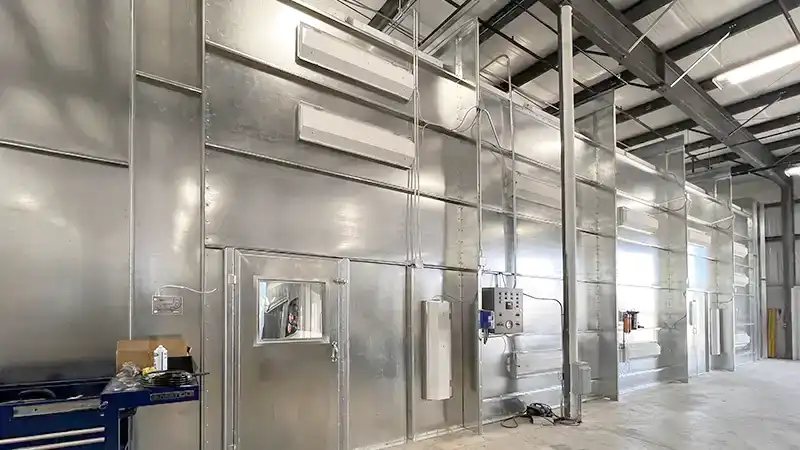
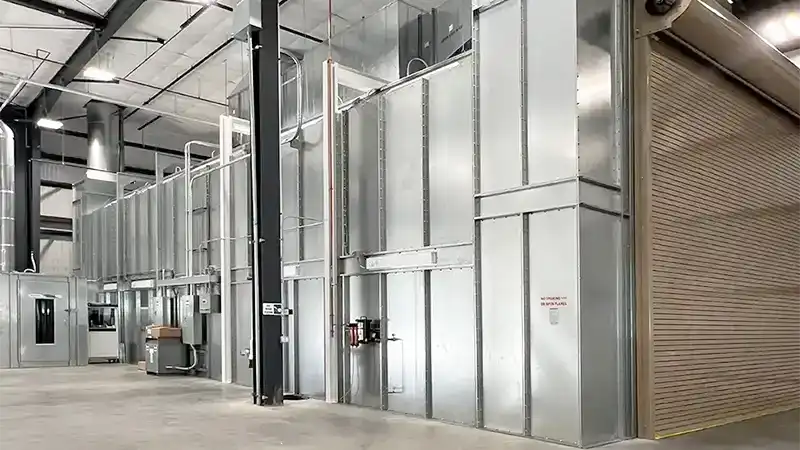
Panels: Panels have Pre-Punched Bolt Holes on 6” Centers. Panels are fabricated from 18-gauge prime quality G-90 galvanized steel. Panels are fastened together with nuts and bolts for maximum rigidity and ease of assembly. Holes are precision CNC punched on 6” centers. Pre-punched holes assure true panel alignment.
Structural Support: Beams and columns are fabricated from formed 10 Gauge Galvanized Steel or W6x9 Steel Beams. Support is placed on maximum 10' centers for added rigidity. Support columns anchor to a concrete floor with special concrete bolts selected for your facility concrete.
Product/Personnel Doors:
Product Doors: Options for coil type roll up doors or standard swing type doors. These doors are provided with a closed cell foam rubber weather stripping seal about the perimeter and a neoprene rubber sweep seal at the threshold. The mounting hardware provided includes a panic type safety latch and four 9'' door pulls.
Personnel Access Doors with Window: Personnel access doors are provided as a double wall 18-gauge galvanized steel unit sized at 36'' x 84” and are provided pre-hung in a heavy gauge steel frame ready for mounting to the spray booth. Mounting hardware includes a panic type safety latch and two 6'' door pulls.
Exhaust System:
Exhaust Fans: A tube axial type duct fan specifically designed and constructed for use in paint spray booths and similar applications is provided for exhaust. A precision balanced, fabricated, aluminum non-sparking fan blade moves the air through the fan. Bearings are mounted in rubber isolators for smooth operation. The motor, drive, and bearings are isolated from the exhaust air stream. The bearings are sized with a minimum average life, per AFBMA, in excess of 200,000 hours when operating at the maximum RPM of the fan size.
Filtration:
Intake Filtration: Intake air filters: Rated by UL as Class 2 and are EPA registered as environmentally safe. Filters are self-supporting in an internal frame - 20'' x 20'' x 1''.
Exhaust Filters: Filtration has six layers of expanded paper to create an alternating labyrinth upstream of a heavy polyester backing. This combination yields higher efficiency while still providing ample holding capacity in a wide variety of applications. Filters are lab tested with over a 99.8% particulate removal efficiency. FilterLoc track is mounted to the exhaust chamber providing a tighter seal to help eliminate overspray bypass. The roll media is secured in the FilterLoc track using the provided FilterLoc Tool. The new technology provides savings by allowing the utilization of roll media reducing overall cost and decreases overall filter change out time.
LED Lighting:
LED Illumination: • Fixtures are Maintenance-Free rated for Class I Division II Groups A, B, C, D; Class II Division II Groups F and G. Fixtures are ETL listed and approved for their intended use and placement. Lighting is provided by innovative LED technologies consisting of multiple high efficiency flux boards paired with high efficiency drivers. Fixtures are designed to accept either 120VAC or 277VAC power. Driver and boards carry a 5-year limited warranty.
Air Makeup Units - Heat and Cure:
Our heat and cure systems are designed to help you move your work through the process as quickly as possible. We offer a basic heat and cure system and another system with heat, flash, and cure modes. The flash mode allows you to dry the paint between coats. Works great for both solvent and water based paints. Our standard paint booth heat and cure system features include a Variable Air Volume System (VAV) and Automatic Booth Pressure Balancing System (AB) which make our air makeup units stand out from the rest. On large equipment booths this can save a lot on operation costs.
Enclosed booths completely isolate the work area from the rest of your facility. Basic crossdraft booths have filtered front doors. The air comes in through the filtered doors moves through the work area and is drawn though a filtered exhaust plenum at the rear of the booth and to the outside of the building through exhaust duct.
Large equipment industrial paint booths require air makeup units to replace the air exhausted by the booth. We can provide a variety of industrial paint booth air makeup systems to replace the air exhausted by your booth. We can also connect an air makeup system directly to an intake plenum on a booth to provide a system that is a "closed loop". Air comes directly from outside the building through the air makeup unit which is connected by ducting directly to the intake plenum on the booth. This allows for having a cure or bake cycle for your booth and also allows for control of the pressure in the booth.
Open Face Booths
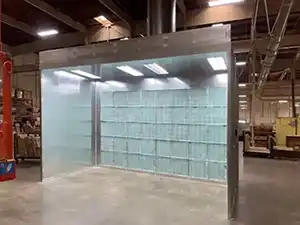
Open face booths offer the convenience of easy access. They are ideal for applications in which fume control, odor control, or overspray control are desired and/or required. We can make open face booths with crane slots for use with overhead crane systems or with conveyor openings for use with different types of material handling and material conveyance equipment.
Booths exhausting to the outside of the building may require air makeup units to replace the air exhausted by the booth. We can also provide an air makeup system to replace the air exhausted by your booth if your application requires exhausting to the outside of your building.
We offer standard open face paint booths in a variety of sizes, 7' Tall, 8' Tall, 10' Tall, and 12' Tall. Standard widths run from 4' to 20'. Standard depths run from 5' to 15'. We can fabricate a booth to custom dimensions for your specific application.
Industrial Paint Booth FAQ's
How to Select Best Size of Paint Booth?
A paint booth should have large enough interior working dimensions to allow for at least 3' clearance around the item you are coating. If you have an item that is 10' wide x 10' tall x 22'
long your booth should have interior working dimensions of 16' wide x 13' tall x 28' long. 16' wide ( 3' on each side of the 10' wide item) x 13' tall (3' above the 10' tall item) x 28' long (3' in front of and 3' behind
22' long item).
Some appications require scaffolding or lifts to reach all areas of the item being painted or it just may feel more comfortable to have more than 3' around the item. The 3' is not
a code requirement.
Keep in mind the cross section of a crossdraft or semi downdraft booth are used to determine the code compliant airflow. A booth that is 16' wide x 13' tall would require 20,800 CFM to provide the code compliant velocity of 100 FPM. 16x13x100 = 20,800 CFM.
Downdraft booths only require 50 FPM but use the width times the length to compute airflow. A booth that is 16' wide x 28' long would require 22,400 CFM . 16x28x50 = 22,400.
What is the Best Airflow for a Paint Booth?
The best airflow for your unique application depends on what you are coating. If your part is a large rectangular cube piece, like a shipping container, and being coated with one color a pressurized crossdraft may be best for you.
If you are doing multiple colors a downdraft booth may help with overspray getting on already coated parts of the piece. If your booth is extra wide, say over 20', a semi downdraft or downdraft may provide more even airflow.
There is no definitive answer because each application is different. It is best to find a supplier with many years of experience with unique applications to help you select the best booth airflow for your application.
Crossdraft Airflow: Air enters the booth through the filtered front doors or filtered intake columns inside of the booth for a pressurized booth. The clean filtered air flows through the work area and is pulled through the filtered exhaust chamber or exhaust columns at the rear of the booth by an exhaust fan.
Semi Downdraft Airflow: The air makeup unit pushes air into the booth through the filtered intake plenum on top of the booth above the front doors. The clean filtered air flows through the work area and is pulled through the filtered exhaust chamber at the rear of the booth by an exhaust fan.
Downdraft Airflow: The air makeup unit pushes air into the booth through the full length filtered intake plenum on top of the booth. The clean filtered air flows through the work area and is pulled through the filtered exhaust chambers at floor level in the side walls of the booth or by a filtered grated pit in the floor of the booth by an exhaust fans.
What Codes Does a Paint Booth Need to Meet?
Your paint booth will need to comply with O.S.H.A., N.E.C., and N.F.P.A., and any Local Codes Unique to Your Location.
O.S.H.A. Your booth and painting procedures will need to comply with the recommendations of the Occupational Safety and Health Organization. This covers worker safety and the safety of all people in the building.
N.E.C. Your booth and painting procedures will need to comply with the recommendations of the National Electric Code. This covers all wiring of your booth, where electrical fixtures are allowed with regard to a paint booth, and the codes for what electrical components are allowed.
N.F.P.A. Your booth and painting procedures will need to comply with the recommendations of the National Fire Protection Association. These are guidelines used by a local fire marshal to make certain your booth complies with all local fire codes. The local fire codes vary according to where you are located. The local fire marshal has final say on whether your booth setup is compliant or not.
What is the Required Clearance Around a Paint Booth?
The booth usually requires 3' of clearance on all sides. If the booth is near an outside wall sometimes the local fire marshall will allow you to move the booth closer to that outside wall.
The reasoning behind this is that if the booth is too close to a common wall with people on the other side of the wall it could create a fire hazard. This is soley up to the local authority having jurisdiction over the requirements that must be met by a paint booth.
How Do You Properly Exhaust/Vent a Paint Booth?
The exhaust from the booth must vent to the outside of the building. The exhaust ducting must terminate no less than 6' above the highest part of the roof.
If the exhaust stack is very close to another building it must terminate 6' above the roof of that building. This requirement is different from state to state. Some states require the exhaust duct termination height to be greater the 6'. Always check with the local permitting officials in your area to get the local requirements.
What Kind of Lighting Do You Need in a Paint Booth?
The inside of the booth is considered an explosive environment. The electrical connections for the lighting must be outside of the booth to avoid having to use explosion proof lighting. Lighting must be vapor tight
to prevent fumes getting to the electronics of the light fixture. All light fixtures within 3' of an opening in the booth must be rated Class 1 Division 2. This includes light fixtures within 3' of all doors or crane slots in the booth.
When Do You Need an Air Makeup Unit?
A paint booth exhausts it's air to atmosphere, outside of the building. If the booth is drawing air through filters in the booth doors or through a filtered intake plenum on top of the booth
it is drawing air from inside of the building. This can create a negative pressure in the building. You need to either provide replacement air for the building or connect an air makeup unit directly to the booth through an intake plenum. Doing this will avoid creating a negative air pressure in the building.
If you desire a cure or bake cycle with your booth you will need to connect the air makeup unit directly to the booth to create a closed loop system.
How Do You Provide Humidity Control in a Paint Booth?
Some products or coatings require humidity controlled environments for applying the coating. Humidity control is accomplished by using an air makeup unit with an air conditioning system to
bring the incoming air below the local dew point to condence the moisture out of the incoming air. These systems can use chilled water or DX cooling to bring the incoming air down to below the local dew point. These humidity control systems often take advantage of a booth recirculating
system to reduce the amount of air being treated. 80-20 systems that recirculate 80% of the booth air and combine that with 20% of treated air help reduce the cost of air conditioning the air down to below dew point temperature.
These systems require constant monitoring of the recirculated air with gas sensors to assure that the air inside of the booth is less than 25% the LFL (Lower Flammable Limit) or LEL (Lower Explosive Limit) of the coatinging being used.
Always work with a supplier that has experience with these systems as they are costly and work at the edges of the requirements for the air inside of a booth.
Some of Our Completed Projects
B&O Railroad Museum -Locomotives
Exterran - All Terrain Lift Equipment
Kalmar RT - Large All Terrain Loaders
Haulmark Trailers - Shipping Trailers
Industrial Rail Services - Rail Cars
Mayekawa - Cranes and Mobile Cranes
Manitowoc Cranes - Mobile Cranes
Waste Management - Waste Vehicles
RCD RV Center- Large RV's
Ram Fab - Pipes and Pressure Vessels
Lectrus - Railcar Mounted Generators
Altec - Cranes and Service Vehicles
U.S. Fire Pump - Fire Pump Trucks
General RV Centers - Large RV's
General Tool - Custom Systems
Haverfield Aviation - Helicopters
DY Concrete Pumps - Pump Trucks
Fort Drum - Helicopter Maintenance
Technibus - Electrical
Bus Enclosures
Stevens Aviation - Aircraft
Sabreliner Aircraft - Aircraft
A B Pipe Liners - Oilfield Equipment
Magnaloy - Hydraulic Equipment
Baldor - Electric Motors
AEI Paint Booths - Serving North America Since 2003 with Creative Engineering and Quality Products